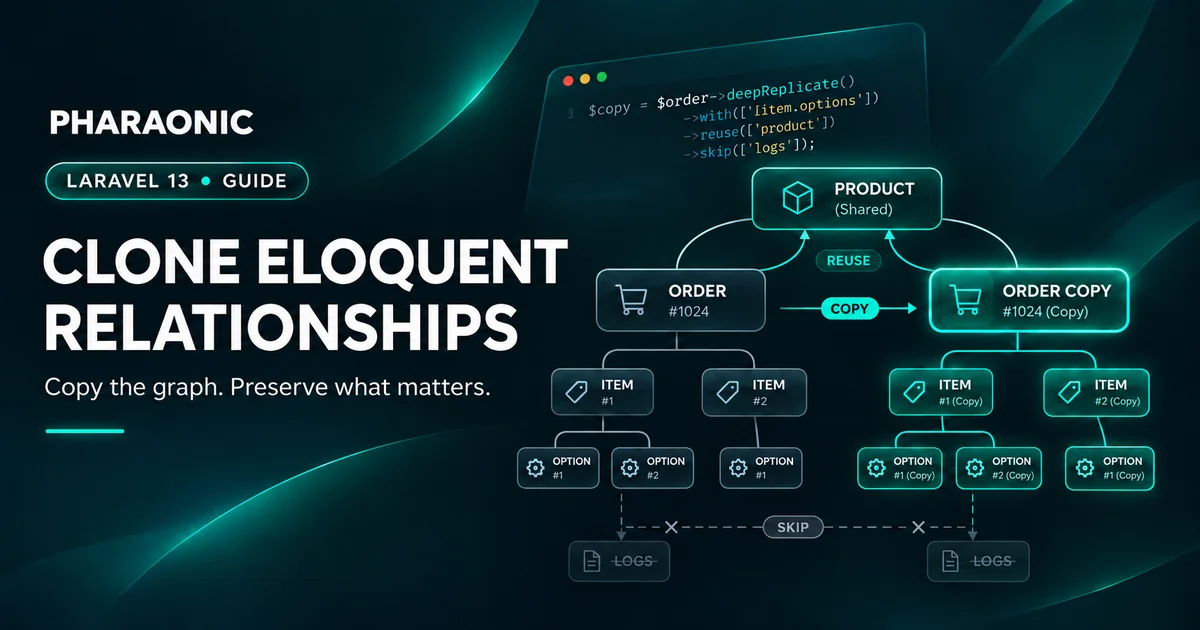
How to Clone Eloquent Models with Nested Relationships Safely in Laravel
Duplicate Eloquent models with nested relations while preserving shared records, rebuilding foreign keys, and avoiding partial or unsafe copies.
On this page
- Draw the Ownership Boundary Before Copying Anything
- What Laravel's replicate() Actually Copies
- Duplicate a Small Graph with Native Laravel
- Where Hand-Written Graph Copying Becomes Fragile
- Express the Copy Policy with Laravel Deep Replicate
- Copy, reuse, and skip are not interchangeable
- Keep Shared Many-to-Many Records Without Losing Pivot Data
- Control Which Source Rows Are Used
- Preview the Graph and Enforce Operational Limits
- Validate Business Rules the Engine Cannot Know
- Unique business identifiers
- Tenant and authorization boundaries
- Transactions, model events, and external effects
- Cycles and mixed relation graphs
- Test the Data Invariants, Not Just the Return Value
- When to Use Each Approach
A customer clicks Duplicate order to prepare a new quote. The new order needs its own items and item options, but those items must still point to the existing products. Its customer remains the same, while payments, shipment history, and other activity must not be duplicated. If an insert fails halfway through, the application must not leave a half-built order behind.
This is a data-ownership problem, not simply a question of copying more rows. Laravel's replicate() handles one model well. The hard part is deciding which relationships own new records, which reference shared data, and which should not participate at all.
Quick Answer / TL;DR: Use Eloquent's
replicate()for a single record. For a small, fixed graph, clone each owned child insideDB::transaction()and reassign its foreign key to the new parent; leave shared foreign keys pointing to their original records. For larger selectable graphs, use explicitcopyandreuserules, with a preview and database constraints to verify the result.
#Draw the Ownership Boundary Before Copying Anything
Suppose an Order has the following relationships:
1Order2├── customer BelongsTo: shared customer3├── items HasMany: order-owned rows4│ ├── options HasMany: item-owned rows5│ └── product BelongsTo: shared catalog product6└── payments HasMany: historical financial activityThe intended result is one new order, new items, new options, but no new customer, products, or payments. The source order and all of its relationships stay unchanged.
A useful decision table is:
| Relation | Desired behavior | Reason |
|---|---|---|
items, items.options | Copy | Each new order needs independently editable rows. |
customer, items.product | Reuse | Identity belongs to another domain record. |
payments | Omit | Copying a historical payment could imply money moved when it did not. |
These decisions are application rules, not properties Eloquent can infer from relation types alone. A BelongsTo relation can represent either a shared catalog product or a parent record you actually want to clone. Think in terms of ownership and identity first, then choose the API.
#What Laravel's replicate() Actually Copies
Laravel provides a native model-level clone:
1use App\Models\Order;2 3$order = Order::query()->findOrFail($orderId);4 5$copy = $order->replicate();6$copy->status = 'draft';7$copy->save();replicate() produces an unsaved model with copied attributes, excluding the original primary key and its standard managed timestamps. It is useful for duplicating a single address, draft, or configuration row. It does not create independent rows for the order's children. Saving the new Order leaves items and items.options in the database attached to the old order.
One subtlety: the native clone may carry already-loaded relation objects in memory. They are not fresh copies of those related database records. Clear them with $copy->unsetRelations() when you do not intend to use that inherited in-memory state. Nor is Eloquent's push() a general-purpose deep-cloning API; its job is to save a model and its loaded relationships, not allocate new identities and relink a graph.
See Laravel's model replication reference and relationship persistence documentation.
#Duplicate a Small Graph with Native Laravel
Assume integer-keyed Eloquent models with standard relations named items, options, product, and customer. The order has a unique number and a status; each item has order_id, product_id, and state; each option has order_item_id. Adapt these names to your schema.
You can solve this particular graph without installing anything:
1use App\Models\Order; 2use Illuminate\Support\Facades\DB; 3use Illuminate\Support\Str; 4 5// $order is an existing, persisted Order model. 6$newOrder = DB::transaction(function () use ($order): Order { 7 $copy = $order->replicate()->unsetRelations(); 8 $copy->number = 'DRAFT-'.Str::upper(Str::random(16)); 9 $copy->status = 'draft';10 $copy->save();11 12 foreach ($order->items()->with('options')->get() as $item) {13 $newItem = $item->replicate()->unsetRelations();14 $newItem->order_id = $copy->getKey();15 $newItem->state = 'pending';16 $newItem->save();17 18 foreach ($item->options as $option) {19 $newOption = $option->replicate()->unsetRelations();20 $newOption->order_item_id = $newItem->getKey();21 $newOption->save();22 }23 }24 25 return $copy;26});Notice what the code does not change: customer_id on the order and product_id on each item. Their original values still identify shared records. payments are never traversed, so no new payment rows are created. with('options') prevents an extra option query for every item, while DB::transaction() rolls back the database inserts together if an exception occurs.
The generated order number still needs a database unique constraint; random generation reduces collisions but does not replace the constraint. Also verify the unique fields and observers on child models before copying them. Laravel documents the database transaction behavior.
For one fixed parent-child structure, this is often the clearest solution. You can see precisely which rows are created and where each foreign key changes.
#Where Hand-Written Graph Copying Becomes Fragile
Now the product manager asks for a second duplication mode: optionally include only active items, copy each item's discounts, keep shared tags with their pivot metadata, and support an article-like polymorphic attachment elsewhere in the product.
The problem stops being the number of foreach loops. You now need to maintain several invariants:
- Identity: if two selected relation paths reach the same database row, do you create one copy or two?
- Dependency order: a copied
BelongsToparent must exist before its child can reference its new key. - Pivots: a new association needs a new pivot row, but the related record may need to remain shared. Some pivot tables also carry extra columns and unique constraints.
- Safety: each copy needs its own unique business identifiers, and all database writes must succeed or fail together.
- Selection: a constrained eager load, a global scope, and a filtered query are not equivalent sources of rows.
A dedicated application service can manage all of this. However, when several features need configurable graph duplication, it is reasonable to reuse a graph replication engine instead of maintaining separate traversal and identity-map implementations.
#Express the Copy Policy with Laravel Deep Replicate
Pharaonic Laravel Deep Replicate exposes explicit path rules rather than silently walking every relationship. The examples below use 13.0.0, released for Laravel 13 with PHP 8.3–8.5. The project also publishes separate release lines for earlier supported Laravel majors; select the line compatible with your application.
1composer require pharaonic/laravel-deep-replicateIts service provider and facade are auto-discovered. No package migration is required. For the same order example:
1use Illuminate\Support\Str; 2use Pharaonic\Laravel\DeepReplicate\Facades\DeepReplicate; 3use Pharaonic\Laravel\DeepReplicate\RelationRule; 4 5$result = DeepReplicate::for($order) 6 ->copy('items.options') 7 ->reuse('items.product', 'customer') 8 ->with(['status' => 'draft']) 9 ->generate('number', fn () => 'DRAFT-'.Str::upper(Str::random(16)))10 ->configure('items', fn (RelationRule $rule) => $rule->with([11 'state' => 'pending',12 ]))13 ->replicate();14 15$newOrder = $result->model();items.options implies copying its items parent. Both paths create new records; the engine links each copied option to its copied item. reuse('items.product', 'customer') retains existing products and customer records. An unselected payments relation remains unvisited.
The output is a persisted root model, not an unsaved Eloquent clone. The whole selected graph is planned, written, and linked in one database transaction. Unlike a method that recursively follows whatever happens to be loaded, the selected paths describe the graph intentionally.
You can also add Pharaonic\Laravel\DeepReplicate\Concerns\DeepReplicates to the Order model and start with $order->deepReplicate('items.options'). That method returns the same builder; Laravel's original replicate() remains unchanged. A deep-replication operation requires at least one copy or reuse path; for root-only copying, use Eloquent's native method. A builder can be previewed repeatedly before execution but can execute replicate() only once.
#Copy, reuse, and skip are not interchangeable
| Strategy | What happens | Common use |
|---|---|---|
copy('items') | New related model rows with new identities | Owned order lines |
reuse('customer') | Link to the same related row | Existing customer |
reuse('tags') | Keep the related tags, create new pivot rows | Shared taxonomy |
skip('payments') | Do not traverse or relink that path | Historical activity |
Important: skip() does not clear a foreign key already stored on the model being copied. An unselected or skipped BelongsTo relation can continue pointing to the original parent. This is often desirable for a customer or product, but dangerous for tenant boundaries or workflow ownership. If you want a different value for an unselected key, set it deliberately with with(), after authorization and validation.
The engine rejects reuse() on HasOne, HasMany, MorphOne, and MorphMany because reassigning those children would take them away from the original parent. Through relations (HasOneThrough, HasManyThrough) and custom relation classes are not traversed for copying. Those limits matter when designing your path policy.
#Keep Shared Many-to-Many Records Without Losing Pivot Data
Suppose orders have a tags() BelongsToMany relation with an extra approved_at pivot column. Duplicating a tag record would be wrong, but losing tag-specific pivot data might also be wrong.
1use Illuminate\Database\Eloquent\Model; 2use Pharaonic\Laravel\DeepReplicate\Facades\DeepReplicate; 3use Pharaonic\Laravel\DeepReplicate\ReplicationContext; 4 5$result = DeepReplicate::for($order) 6 ->copy('items.options') 7 ->reuse('tags') 8 ->generate('number', fn () => 'DRAFT-'.bin2hex(random_bytes(8))) 9 ->transformPivot('tags', function (10 array $attributes,11 ?Model $sourcePivot,12 ReplicationContext $context13 ): array {14 $attributes['approved_at'] = null;15 16 return $attributes;17 })18 ->replicate();This creates new pivot rows pointing to the existing tags. The original pivots and tag models remain unchanged. The transform resets the approval field for the new association. The package copies pivot attributes by default, including fields not configured with withPivot() when it queries the database itself; it does not collapse duplicate pivot rows with sync().
Be careful with independent unique columns on pivot tables. A copied token or external reference may violate its unique constraint unless you replace it in transformPivot(). For a many-to-many path, copy('tags') has a different meaning: create new tag models as well as new pivot links. See Laravel's many-to-many relationship documentation.
#Control Which Source Rows Are Used
A previously eager-loaded relationship may contain only a subset. A user interface could have loaded the five newest items, but the duplication action should usually consider all items. Deep Replicate queries selected relationships afresh by default, honoring their relation constraints and global scopes.
When duplication rules require a subset, specify the constraint explicitly:
1$result = DeepReplicate::for($order)2 ->copy('items.options')3 ->filter('items', fn ($query) => $query->where('state', 'active'))4 ->generate('number', fn () => 'DRAFT-'.bin2hex(random_bytes(8)))5 ->replicate();When a precisely constrained, already-loaded snapshot is itself the intended input, use usingLoaded() instead. Every requested path must be loaded on all relevant source models:
1$order->load('items.options');2 3$result = DeepReplicate::for($order)4 ->copy('items.options')5 ->usingLoaded('items', 'items.options')6 ->generate('number', fn () => 'DRAFT-'.bin2hex(random_bytes(8)))7 ->replicate();Do not combine filter() and usingLoaded() on the same path; the builder rejects that conflict. And remember that a loaded pivot only carries columns that were loaded. If those rows require additional pivot columns, eager-load them with withPivot() or let the engine query the source relations itself.
#Preview the Graph and Enforce Operational Limits
A destructive database operation deserves a cheap way to inspect its scope, even if the plan itself is read-only. Build the rule set once, inspect it, then replicate it:
1$builder = DeepReplicate::for($order) 2 ->copy('items.options') 3 ->reuse('items.product', 'customer') 4 ->generate('number', fn () => 'DRAFT-'.bin2hex(random_bytes(8))); 5 6$plan = $builder->dryRun(); 7 8if ($plan->estimatedModels() > 3000 || $plan->estimatedPivotRows() > 5000) { 9 throw new DomainException('This order is too large to duplicate.');10}11 12foreach ($plan->warnings() as $warning) {13 logger()->warning('Replication plan warning', [14 'code' => $warning->code(),15 'path' => $warning->path(),16 'message' => $warning->message(),17 ]);18}19 20$result = $builder21 ->maxModels(3000)22 ->maxPivotRows(5000)23 ->replicate();24 25$result->stats()->copiedModels();26$result->stats()->reusedModels();27$result->stats()->pivotRowsCreated();dryRun() issues planning queries but writes no database rows and does not run model events, generators, transforms, or lifecycle callbacks. Its estimates can become stale if source data changes; replicate() plans again within its transaction. The limits are checked before inserts, so you should keep them on the actual operation even after previewing.
The defaults are a maximum relation depth of 10, 10,000 planned models (copied and reused), 50,000 pivot rows, and a relation/pivot chunk size of 500. The engine still holds the planned graph in memory and inserts copied models individually. For very large datasets, a streaming, domain-specific batch job can be more appropriate.
#Validate Business Rules the Engine Cannot Know
A graph engine can preserve database relationships, but it cannot decide whether a business operation is appropriate. Production duplication needs a few deliberate checks.
#Unique business identifiers
Primary keys are regenerated; unique slugs, invoice numbers, SKUs, or external IDs are not automatically suffixed. Use generate() or configure() for relevant copied paths, and enforce uniqueness in the database. Do not retry arbitrary replication callbacks after a unique failure unless you have designed them to be safe to run again.
#Tenant and authorization boundaries
Global scopes stay active by default, but a scope is not a substitute for an authorization check. Verify that the actor can read the source and create the copy in the target context. A copied root may retain tenant_id or customer_id if those fields are unselected; a copied child's tenant key may also need an explicit policy. The withoutGlobalScopes() option removes all relation-query global scopes, including tenant and soft-delete scopes, so it should never be the default workaround for missing children.
#Transactions, model events, and external effects
Replication runs in one transaction on the source model's database connection; it rejects graphs spanning different connections. Eloquent events run unless withoutEvents() is requested. Database rollback cannot undo email, HTTP requests, file copies, or other external work started by observers. Schedule those effects after commit, or use a transactional outbox.
For example:
1use Pharaonic\Laravel\DeepReplicate\Facades\DeepReplicate; 2use Pharaonic\Laravel\DeepReplicate\ReplicationResult; 3 4DeepReplicate::for($order) 5 ->copy('items.options') 6 ->generate('number', fn () => 'DRAFT-'.bin2hex(random_bytes(8))) 7 ->afterCommit(function (ReplicationResult $result): void { 8 // Dispatch your application job only after the outer transaction commits. 9 \App\Jobs\IndexClonedOrder::dispatch($result->model()->getKey());10 })11 ->replicate();The job shown is an application-owned job you would implement. The package does not copy uploaded files or cloud objects when a copied model contains their paths. It does not make external side effects transactional.
#Cycles and mixed relation graphs
The engine deduplicates copied records by identity across selected paths and can resolve some foreign-key cycles by temporarily inserting a nullable link and updating it later. A non-nullable cycle that cannot be broken safely fails and rolls back. MorphTo and many polymorphic relation types are supported, but through relations and arbitrary custom relation classes are not. Test your specific graph, especially if a polymorphic path reaches models with different relation definitions.
#Test the Data Invariants, Not Just the Return Value
For an order seeded with at least one item and its options, the result should prove that new and shared identities were handled differently. In a PHPUnit feature test, after creating the fixture $order:
1use Pharaonic\Laravel\DeepReplicate\Facades\DeepReplicate; 2 3$oldItem = $order->items()->firstOrFail(); 4$oldProductId = $oldItem->product_id; 5$oldOptionCount = $oldItem->options()->count(); 6 7$result = DeepReplicate::for($order) 8 ->copy('items.options') 9 ->reuse('items.product', 'customer')10 ->generate('number', fn () => 'DRAFT-'.bin2hex(random_bytes(8)))11 ->replicate();12 13$copy = $result->model();14$newItem = $result->map()->get($oldItem);15 16$this->assertNotEquals($order->getKey(), $copy->getKey());17$this->assertNotEquals($oldItem->getKey(), $newItem->getKey());18$this->assertEquals($oldProductId, $newItem->product_id);19$this->assertEquals($order->customer_id, $copy->customer_id);20$this->assertSame($oldOptionCount, $newItem->options()->count());21$this->assertSame(0, $copy->payments()->count());The final assertion assumes your Order model has a payments() relationship. Add separate failure-path tests for uniqueness violations, observer exceptions, tenant-scoped data, and pivot constraints. In each test, assert that no partial copy was committed and that the source still references its original children.
#When to Use Each Approach
| Situation | Prefer |
|---|---|
| Clone only a single model with adjusted attributes | Native replicate(). |
| Copy a fixed one- or two-level graph in one feature | A small, explicit DB::transaction() service. |
| Repeatedly duplicate configurable nested graphs with mixed shared and owned relations | Deep Replicate with explicit path policies. |
| Rebuild domain data using bespoke pricing, inventory, payments, or other irreversible rules | A dedicated domain workflow; reuse the package only for the safe subgraph, if useful. |
| Copy millions of records, cross-database data, or binary assets | A specialized migration/batch/export process, not a single in-memory graph replication. |
The goal is not to make replicate() recursive by default. It is to preserve the meaning of each relationship as new identities are allocated. Start with native Eloquent when its explicitness is an advantage; introduce a graph engine when the same ownership and linking problems recur across features.
For the complete option reference and support matrix, consult the package documentation and the 13.x source and tests.
Related Packages
Related Guides
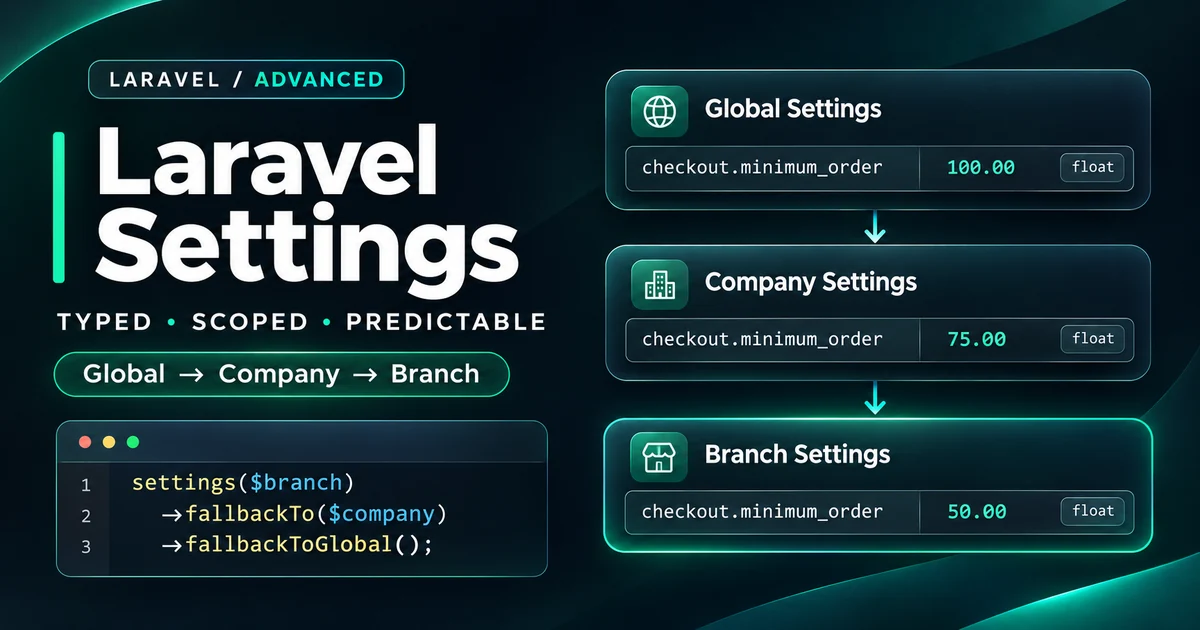
How to Build Inherited Model Settings in Laravel Without Fallback Bugs
Design Laravel settings that inherit across companies and branches, distinguish missing values from null, and prevent unsafe tenant overrides.
How to Remove Stale Database Notifications in Laravel
Learn how to clean up Laravel database notifications when an order or comment is deleted, from a simple Eloquent observer to explicit model dependencies.
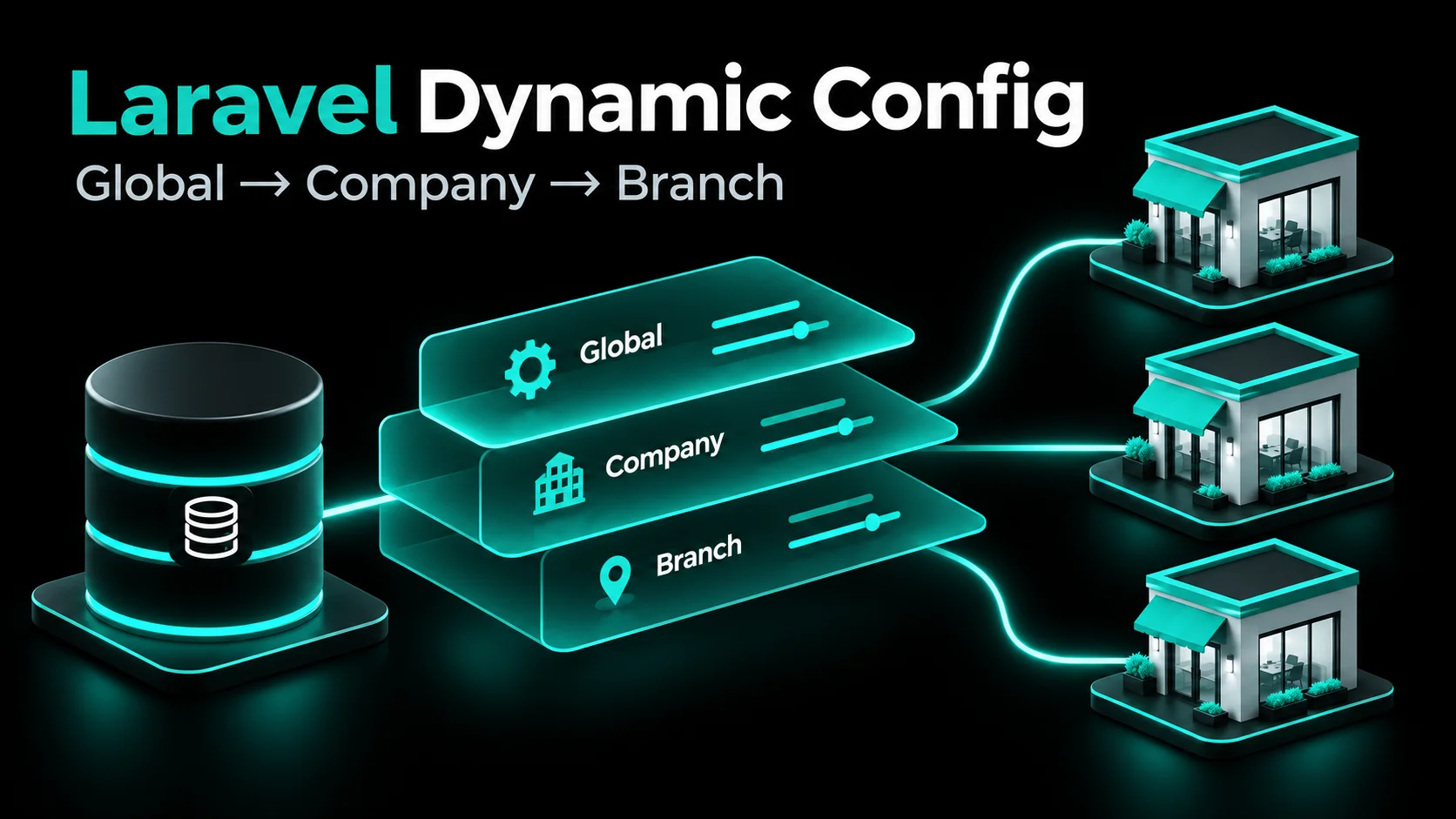
Laravel Dynamic Configuration Without Redeploys: A Multi-Tenant Guide
Persist Laravel config overrides in the database, layer global and tenant scopes, and handle runtime loading, caching, and queues without redeploying.